If you are trying to picture what life in Arcadia really feels like, start with the weekend. This is not a neighborhood that announces itself with one big entertainment strip or one neat set of borders. Instead, Arcadia feels lived-in, local, and ritual-driven, with mornings on the canal, coffee by sunrise, park time before lunch, and dinner spots that ease you into the evening. Let’s dive in.
What Arcadia feels like
Arcadia is best understood as a micro-market rather than a single rigid shape on a map. Local Phoenix records place the core Arcadia Camelback area roughly between 44th Street and 64th Street, with Indian School Road to the south and the Stanford Drive alignment across Camelback Mountain to the north. A Phoenix historic survey also describes the commonly referenced area as north of the Arizona Canal and south of Camelback Mountain between 44th Street and Scottsdale Road.
That matters because when people talk about Arcadia, they are often talking about a cluster of related sub-areas rather than one exact boundary. In day-to-day terms, what ties it together is less a line on a map and more a shared rhythm. You see that rhythm in the mature residential streets, the proximity to Camelback Mountain, the canal paths, and the concentrated dining nodes around Indian School, Camelback, Campbell, and 40th Street.
Phoenix planning documents describe Arcadia Camelback as a mature neighborhood with a distinct setting at the foot of Camelback Mountain, recognizable landscape character, and a pattern of uniform home quality. The area’s origins help explain that feeling. Historic city records trace Arcadia’s development to large-lot rural estate subdivision planning after Roosevelt Dam, with citrus-orchard ambitions and a strong emphasis on residential character.
Arcadia weekends start early
If you spend a few weekends in Arcadia, one pattern becomes clear. The day tends to start early, especially for anyone heading outdoors before the heat builds. That early start is reflected in the area’s canal access, park hours, trailhead rules, and the number of coffee and breakfast spots that open by 6:30 or 7 a.m.
The result is a neighborhood cadence that feels easy to settle into. You might begin with a walk or ride, stop for coffee, stretch brunch into late morning, then circle back out for dinner or a patio meal later on. Arcadia feels less like a nightlife district and more like a place where everyday routines happen to be especially enjoyable.
Canal trails anchor everyday life
For many people, the easiest outdoor habit in Arcadia is the canal trail system. SRP says these canal trails across Greater Phoenix are free to use and designed for walking, running, biking, and other recreation. The network now includes more than 80 miles of trails, with paved paths, lighting, landscaping, and public art.
That practical accessibility is part of Arcadia’s appeal. You do not need to plan a full outing to enjoy the canal. It can be a quick morning walk, an after-work bike ride, or part of a longer weekend loop through the neighborhood.
One standout stop along the Arizona Canal is Arizona Falls. SRP notes that it has been a local gathering place since the 1800s and today blends art, history, and hydroelectric power. It is a good example of how Arcadia’s outdoor spaces often feel both functional and rooted in local identity.
Why the canal works so well
The canal trails fit the everyday side of Arcadia because they are easy to access and easy to repeat. They support the kind of routine that makes a neighborhood feel livable, not just visitable.
That is a big part of Arcadia’s appeal for buyers who care about lifestyle. The best neighborhood amenities are often the ones you will actually use on a Tuesday morning, not just once a season.
Camelback brings the dramatic side
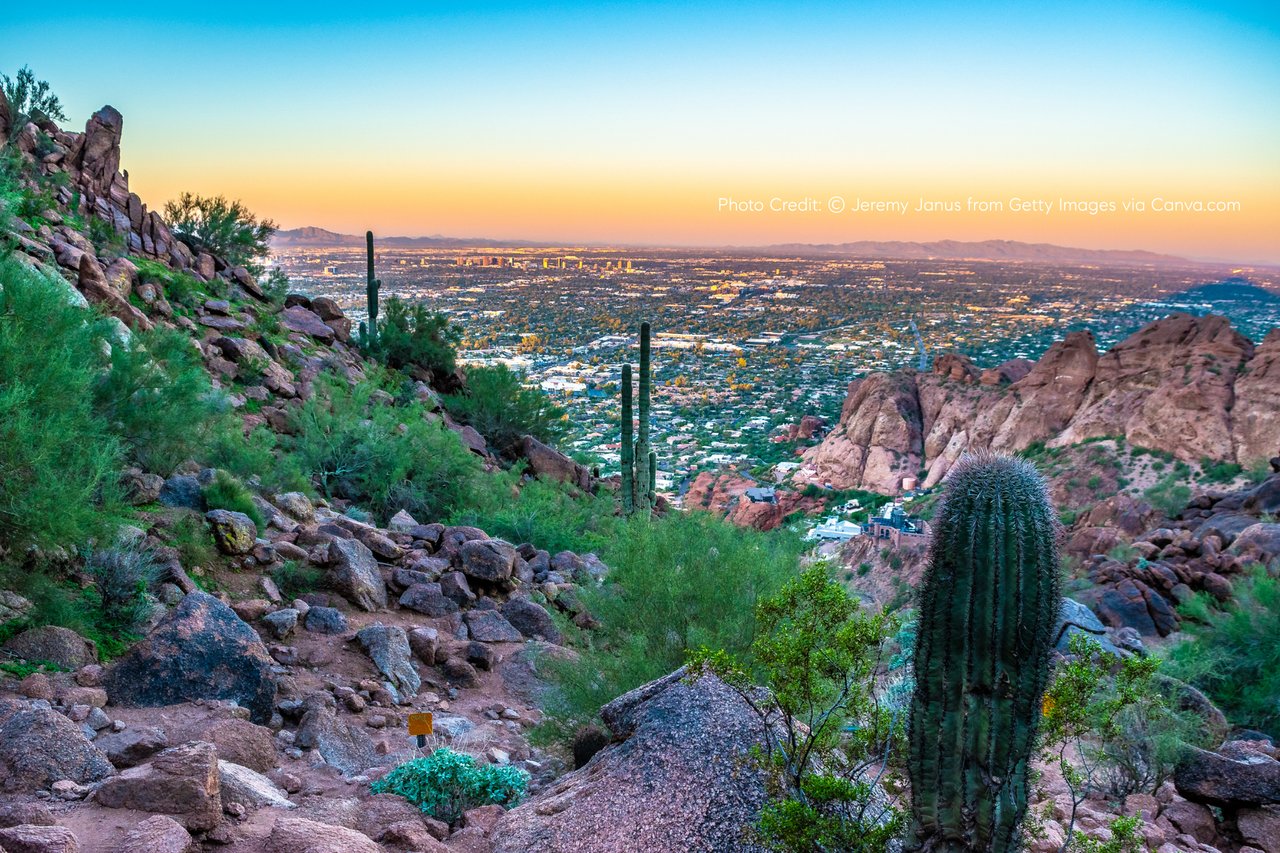
Camelback Mountain gives Arcadia one of its most recognizable natural backdrops, but it is important to frame it accurately. The City of Phoenix rates both the Cholla and Echo Canyon trails as extremely difficult. The city also notes that Echo Canyon is one of Phoenix’s premier hiking destinations and regularly a top national destination for experienced hikers.
In other words, Camelback is not a casual neighborhood stroll. It is a serious hike that draws heavy weekend traffic, and the city warns that visitation is very high and parking is limited. Trailheads are open from sunrise to sunset.
If you are comparing the two main access points, the city notes some practical differences. Echo Canyon has restrooms, benches, potable water, and a small shade canopy. Cholla has very limited parking and no potable water or restroom facilities at the trailhead.
Camelback versus everyday Arcadia
This contrast says a lot about Arcadia. Camelback gives the area a sense of destination and drama, but the day-to-day outdoor rhythm is usually easier and more repeatable. For most weekends, the canal path or Arcadia Park is the simpler choice.
That balance is part of what makes the neighborhood compelling. You have a major landmark nearby, but you also have lower-key options that fit regular life.
Arcadia Park keeps things simple
Arcadia Park offers a more relaxed neighborhood option when you want outdoor time without the intensity of a mountain hike. The City of Phoenix lists the park at 3402 N. 56th Street, and it is open daily from 5:30 a.m. to 10 p.m.
The park includes ADA access, drinking fountains, a grill and picnic area, a playground, restrooms, shade structures, and a volleyball court. Those details matter because they make the park usable for a wide range of everyday plans. You can stop by for a quick outing, meet friends for picnic time, or build it into a simple weekend routine.
In lifestyle terms, Arcadia Park helps explain why Arcadia feels grounded. The neighborhood offers signature scenery and known destinations, but it also delivers the kind of practical green space that supports ordinary weekends.
Dining follows the day
Arcadia’s dining scene is compact, but it has a clear pattern. Morning coffee and breakfast lead into brunch, then long lunches, patio dinners, and happy hour. Because many of the well-known spots open early and cluster near key corridors, the area feels concentrated and easy to navigate.
That concentration changes how a weekend feels. Instead of planning a full cross-town outing, you can move through the day in a smaller radius. Coffee, breakfast, a walk, a lunch stop, and dinner can all feel connected to the neighborhood rather than spread across the city.
Morning coffee and breakfast
Black Cat Coffee House, in Arcadia Towne Center, is a strong example of the area’s early coffee culture. It describes itself as a locally sourced artisan coffeehouse and is open daily from 6 a.m. to 6 p.m.
La Grande Orange Grocery & Pizzeria at 4410 N. 40th Street is another longstanding Arcadia morning stop. Its concept combines a curated general store, wine shop, pizzeria, and breakfast gathering place, and it opens every day starting at 6:30 a.m.
Over Easy at Arcadia Indian School has served Arcadia neighbors since 2008 and focuses on made-from-scratch breakfast, brunch, and lunch. The restaurant opens daily at 6:30 a.m. and uses a digital waitlist rather than reservations.
All-day and evening options
The Henry Phoenix at 4455 E. Camelback Road captures Arcadia’s all-day rhythm especially well. Its coffee bar opens daily starting at 7 a.m., with breakfast on weekdays, weekend brunch, happy hour, and dinner.
Postino Arcadia, located in a 1940s brick post office in the heart of Arcadia, is open daily from 11 a.m. to 11 p.m. That makes it a useful example of the neighborhood’s lunch-to-dinner flexibility.
Minnow shows another side of the area’s dining scene. It shifts from a morning matcha and coffee bar into sushi, cocktails, and dinner service, opening daily at 7 a.m. to 8 p.m., with later hours on Friday and Saturday.
Why Arcadia feels different
What stands out in Arcadia is how strongly the residential setting shapes the lifestyle. Phoenix planning materials describe the neighborhood as mature and residential, with a focus on preserving that character. The most visible activity gathers at the canal path, Arcadia Park, Camelback trailheads, and the restaurant cluster, rather than filling every block.
That gives Arcadia a different feel than a dense entertainment district. It is active, but not noisy in identity. It is social, but much of that social life revolves around routines like morning coffee, brunch, outdoor time, and early evening meals.
For buyers, that distinction matters. If you are looking for a neighborhood where lifestyle is woven into everyday habits instead of concentrated in one nightlife zone, Arcadia offers a strong example of that balance.
What this means for homebuyers
Lifestyle is one of the most important parts of neighborhood fit, especially in a place as nuanced as Arcadia. A map can show you streets and boundaries, but it cannot fully capture how a place moves from sunrise to sunset. That is where local context becomes valuable.
Arcadia is especially appealing if you want a neighborhood with a strong residential core and easy access to established routines. The combination of canal paths, park space, a nearby mountain destination, and concentrated dining gives the area a rhythm that feels both polished and practical.
Because Arcadia is often discussed as a cluster of related sub-areas rather than one rigid polygon, neighborhood guidance also matters when you begin comparing blocks, home styles, and daily access points. The difference between being near a canal route, close to a dining node, or tucked deeper into a residential pocket can shape your experience more than a broad label alone.
If you are exploring Arcadia as your next move, it helps to work with someone who understands not just the inventory, but the lived patterns behind it. For tailored guidance on Arcadia homes, off-market opportunities, and the nuances between one pocket and the next, schedule a private consultation with Heather MacLean.
FAQs
Where are the boundaries of Arcadia in Phoenix?
- Arcadia is commonly treated as a broad micro-market rather than one rigid boundary. Local Phoenix records place the core roughly between 44th Street and 64th Street, with Indian School Road to the south and the Stanford Drive alignment across Camelback Mountain to the north, while historic records also use a broader north-of-canal, south-of-Camelback description.
Is Camelback Mountain an easy hike for Arcadia residents?
- No. The City of Phoenix rates both the Cholla and Echo Canyon trails as extremely difficult, and weekend visitation is high with limited parking.
What are the easiest outdoor options in Arcadia?
- The canal trails and Arcadia Park are the easiest everyday choices. SRP says canal trails are free and built for walking, running, biking, and recreation, and Arcadia Park offers shade, restrooms, drinking fountains, playground space, and long daily hours.
What kind of dining scene does Arcadia have?
- Arcadia’s dining scene is compact and daypart-driven, with strong options for early coffee, breakfast, brunch, lunch, happy hour, and dinner clustered around corridors like Indian School, Camelback, Campbell, and 40th Street.
Is Arcadia more nightlife-focused or lifestyle-focused?
- The overall pattern is more lifestyle-focused. Based on park access, trail use, and restaurant hours, Arcadia’s weekend rhythm centers more on coffee, brunch, canal walks, park time, and dinner than on late-night activity.