Are you drawn to the Camelback Corridor but not sure which part actually fits the way you live? That is a common challenge, because the Camelback Corridor is less one defined neighborhood and more a collection of distinct pockets with very different day-to-day experiences. If you are deciding between walkable convenience, resort-style privacy, classic residential streets, or mixed-use access, this guide will help you narrow the field. Let’s dive in.
Why Camelback Corridor Feels So Different
In city planning terms, this part of Phoenix sits within Camelback East Village, which includes overlapping cores, corridor plans, and neighborhood overlays. Phoenix identifies two primary cores in the village, including 24th Street and Camelback Road, and notes that the area includes a wide range of neighborhood types with much of the housing built between 1950 and 1970.
That matters when you start home shopping. Two homes may both be labeled “Camelback Corridor,” but the lifestyle around them can feel very different depending on the street, the surrounding land uses, and how close you are to major retail, restaurants, canal paths, or resort amenities.
A practical way to think about the area is through four lifestyle pockets: the Biltmore core, Arizona Biltmore Estates, Arcadia proper, and the 44th Street/Camelback transition pocket. Each one offers a different balance of privacy, convenience, neighborhood character, and access.
Biltmore Core: Best for Walkable Convenience
The Biltmore core centers around 24th Street and Camelback Road. This is the part of the corridor most closely tied to major retail and dining, with Biltmore Fashion Park serving as a major anchor for shopping and restaurants in the area.
Phoenix planning materials describe this core as a place where people walk through neighborhoods, with the canal banks and the retail environment supporting that experience. If you want to be close to errands, restaurants, and a more active day-to-day setting, this pocket often feels like the most connected option.
The nearby Biltmore neighborhood association defines its neighborhood roughly from 24th Street to 32nd Street, between Lincoln Drive and Camelback Road, and emphasizes preserving its residential character. That combination gives this pocket an interesting mix: strong convenience near the core, with quieter residential streets nearby.
Who Usually Prefers the Biltmore Core
This pocket may suit you if you want:
- Easy access to dining and shopping
- A more urban-resort feel
- Walking routes near the canal and retail areas
- A central location within the corridor
If your ideal day includes coffee, lunch, dinner, or errands without driving far, the Biltmore core is often the first place to explore.
Arizona Biltmore Estates: Best for Privacy and Amenities
If your priority is a more managed, resort-adjacent setting, Arizona Biltmore Estates may be the better fit. ABEVA serves as the master HOA for residential properties and certain commercial properties in the Biltmore area, covering 17 residential communities and providing a 24/7 roving patrol.
That structure tends to create a more private and organized feel than the public-facing energy around 24th and Camelback. For some buyers, that consistency is a major advantage, especially if you value a lock-and-leave lifestyle or prefer a neighborhood with a stronger HOA presence.
The Arizona Biltmore resort reinforces the overall character of this pocket. The resort describes the area as a peaceful desert setting near the Phoenix Mountain Preserve, while still offering convenient access to both Downtown Phoenix and Old Town Scottsdale.
What Sets This Pocket Apart
This pocket stands out for amenity-rich living. The resort includes:
- Seven pools
- Two golf courses
- Seven dining outlets
- A spa and salon
- Retail shops
If your lifestyle leans more toward privacy, established communities, and resort surroundings than daily retail walkability, this part of the corridor may feel like the strongest match.
Arcadia Proper: Best for Classic Neighborhood Feel
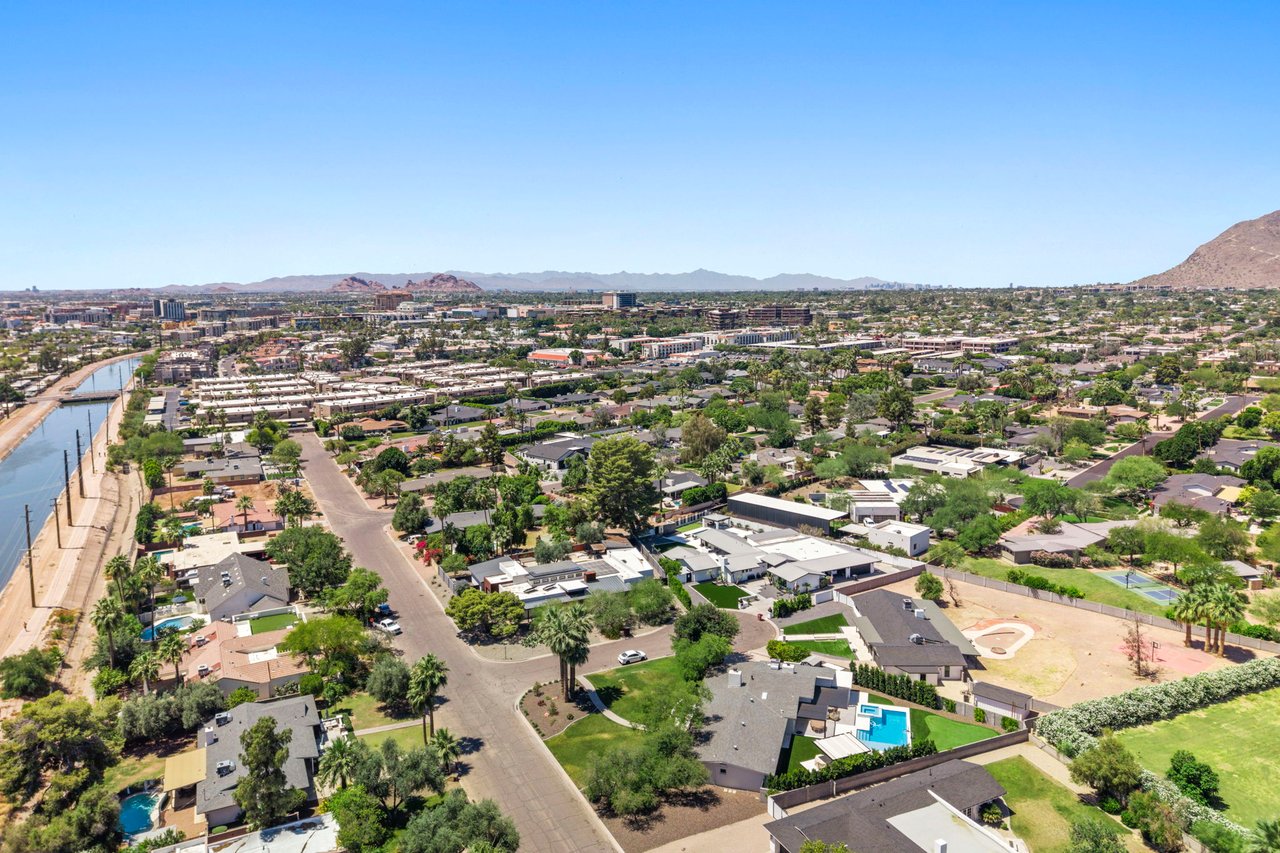
Arcadia proper is commonly described as the area north of the Arizona Canal and south of Camelback Road, between 44th Street and Scottsdale Road. This pocket is widely known for its strongly residential feel, with large lots, generous setbacks, and long-established neighborhood character.
The Arcadia Camelback Mountain Neighborhood Association describes the area as non-commercial in character, with historic citrus trees and a green desert oasis feel. Visit Phoenix also highlights Arcadia for its historic charm, leafy streets, mid-century ranch homes, and laid-back but stylish atmosphere.
For many buyers, Arcadia offers a very specific kind of appeal. It feels more like a classic Phoenix neighborhood first, with dining and lifestyle amenities woven around it rather than dominating it.
Why Buyers Gravitate to Arcadia
Arcadia often appeals if you want:
- Larger residential lots
- A more traditional single-family setting
- Established streetscapes and mature landscaping
- Strong dining access nearby
Dining is one of Arcadia’s biggest practical strengths. Well-known spots are clustered near Camelback Road, 40th Street, and Indian School Road, which gives many residents easy access to local favorites while preserving the area’s residential identity.
A Note on Walkability in Arcadia
Arcadia is not uniformly walkable in the same way a denser retail node can be. Instead, it tends to be pocket-based.
Some locations offer attractive access to dining, canals, and outdoor routes, while many daily errands still remain car-oriented because of the neighborhood’s larger lots and residential layout. If you love Arcadia’s character, the exact street can make a big difference in how connected your day-to-day routine feels.
44th Street/Camelback: Best for Access and Flexibility
The 44th Street/Camelback transition pocket is the most mixed-use part of the corridor. Phoenix’s 44th Street Corridor Specific Plan covers roughly a quarter-mile on either side of 44th Street from just north of Camelback Road south toward Sky Harbor Airport.
City materials describe a mix of commercial, office, and single-family uses in and around this corridor, with additional multi-family housing and 1960s-era single-family development nearby. That blend gives the area a more transitional feel than the more purely residential parts of Arcadia or the more resort-oriented parts of the Biltmore area.
This pocket is often a strong fit if you prioritize convenience, access, and flexibility over a highly defined neighborhood identity. It can be especially appealing if your routine involves commuting, airport access, office proximity, or quick connections across central Phoenix.
When This Pocket Makes Sense
You may prefer this pocket if you value:
- Mixed-use surroundings
- Easier access to major routes
- Proximity to office and retail uses
- A practical location for commuting
For some buyers, that convenience is the biggest lifestyle upgrade of all.
How to Choose the Right Pocket
If you are comparing these areas, start with how you want your week to feel, not just how you want the house itself to look. The right fit often comes down to whether you want your home base to feel lively, private, classic, or highly connected.
Here is a simple way to frame it:
- Choose the Biltmore core if you want the strongest combination of dining, retail, and day-to-day convenience.
- Choose Arizona Biltmore Estates if you value privacy, HOA structure, and resort-style surroundings.
- Choose Arcadia proper if you want a classic residential setting with larger lots and strong nearby dining.
- Choose 44th Street/Camelback if access, mixed-use convenience, and commute efficiency matter most.
Why Street-by-Street Guidance Matters
One of the most important things to know is that Camelback Corridor boundaries are not always simple. The area is shaped by city planning layers, specific plans, and commonly used neighborhood definitions, so exact location matters.
That is why broad labels only get you so far. A home may be marketed with a familiar area name, but your actual lifestyle will depend on the micro-location, nearby uses, and how that property sits within the pocket.
For buyers and sellers alike, this is where hyper-local guidance becomes valuable. Understanding whether a property feels more Biltmore, Arcadia, or corridor-transition in daily life can shape pricing, demand, and overall fit.
If you are weighing where to focus your search or how to position a home within the Camelback Corridor, Heather MacLean offers the kind of neighborhood-first insight that helps you move with more clarity and confidence.
FAQs
What is the Camelback Corridor in Phoenix?
- The Camelback Corridor is best understood as a lifestyle shorthand within central Phoenix rather than one single formal neighborhood, with distinct pockets inside Camelback East Village.
Which Camelback Corridor pocket is best for walkability?
- The Biltmore core around 24th Street and Camelback Road is generally the best fit for daily walkability, especially for buyers who want easy access to retail, dining, and canal-side routes.
What is Arcadia proper within the Camelback Corridor area?
- Arcadia proper is commonly described as the area north of the Arizona Canal and south of Camelback Road, between 44th Street and Scottsdale Road, with a strongly residential character.
Is Arizona Biltmore Estates different from the Biltmore core?
- Yes, Arizona Biltmore Estates tends to feel more private and HOA-structured, while the Biltmore core is more tied to retail, restaurants, and a busier daily convenience pattern.
Which Camelback Corridor pocket is best for commuting?
- The 44th Street/Camelback transition pocket is usually the strongest fit for buyers who prioritize access, office proximity, and convenience to major routes.
Why do Camelback Corridor boundaries matter when buying a home?
- Boundaries matter because the corridor includes overlapping planning areas and neighborhood definitions, so the exact street can have a big impact on lifestyle, access, and property positioning.