
Drive down Lafayette or Exeter on a summer morning and you immediately understand why Arcadia feels different from almost anywhere else in Phoenix. Mature trees arch over the streets, old citrus still grows behind many of the original homes, and deep green lawns and hedges soften a landscape that, just a few miles away, looks unmistakably desert.
That didn’t happen by accident.
Water has shaped Arcadia from the beginning.
Before the large ranch homes, before the remodels and new construction, this was agricultural land—citrus groves, date palms and farmsteads stretching beneath Camelback Mountain. The neighborhood we now call Arcadia grew out of those groves, and remnants of that agricultural history are still very much part of owning a home here.
Flood irrigation is one of them. Arcadia Water Company is another.
After nearly three decades selling homes here, I find that buyers are often surprised by how much the history of Arcadia’s water still matters property by property. Two homes only a few streets apart can have very different water and irrigation situations. It is one of those wonderfully specific Arcadia details that is worth understanding before you buy.
Arcadia Was Green Long Before It Was a Neighborhood
Much of what we think of as traditional Arcadia was once planted in citrus.
As Phoenix expanded eastward during the early and mid-1900s, pieces of the groves were gradually divided into residential parcels. That history helps explain something buyers notice immediately: Arcadia doesn’t have the uniform lot pattern of a master-planned neighborhood.
Drive Lafayette, Exeter, Calle del Medio or Calle Tuberia and you see it. Deep lots, unusual parcel shapes, private lanes, old ranch houses tucked behind mature landscaping and streets that don’t always follow the predictable pattern found elsewhere in Phoenix.
Many of those property lines have roots in the old agricultural parcels.
And the water infrastructure evolved along with them.
SRP Flood Irrigation: A Piece of Old Arcadia That Still Works
Salt River Project’s canal system brought water from the Salt and Verde rivers to the farms and citrus groves of early Phoenix. When Arcadia’s agricultural properties were divided and homes replaced many of the groves, some parcels retained access to flood irrigation.
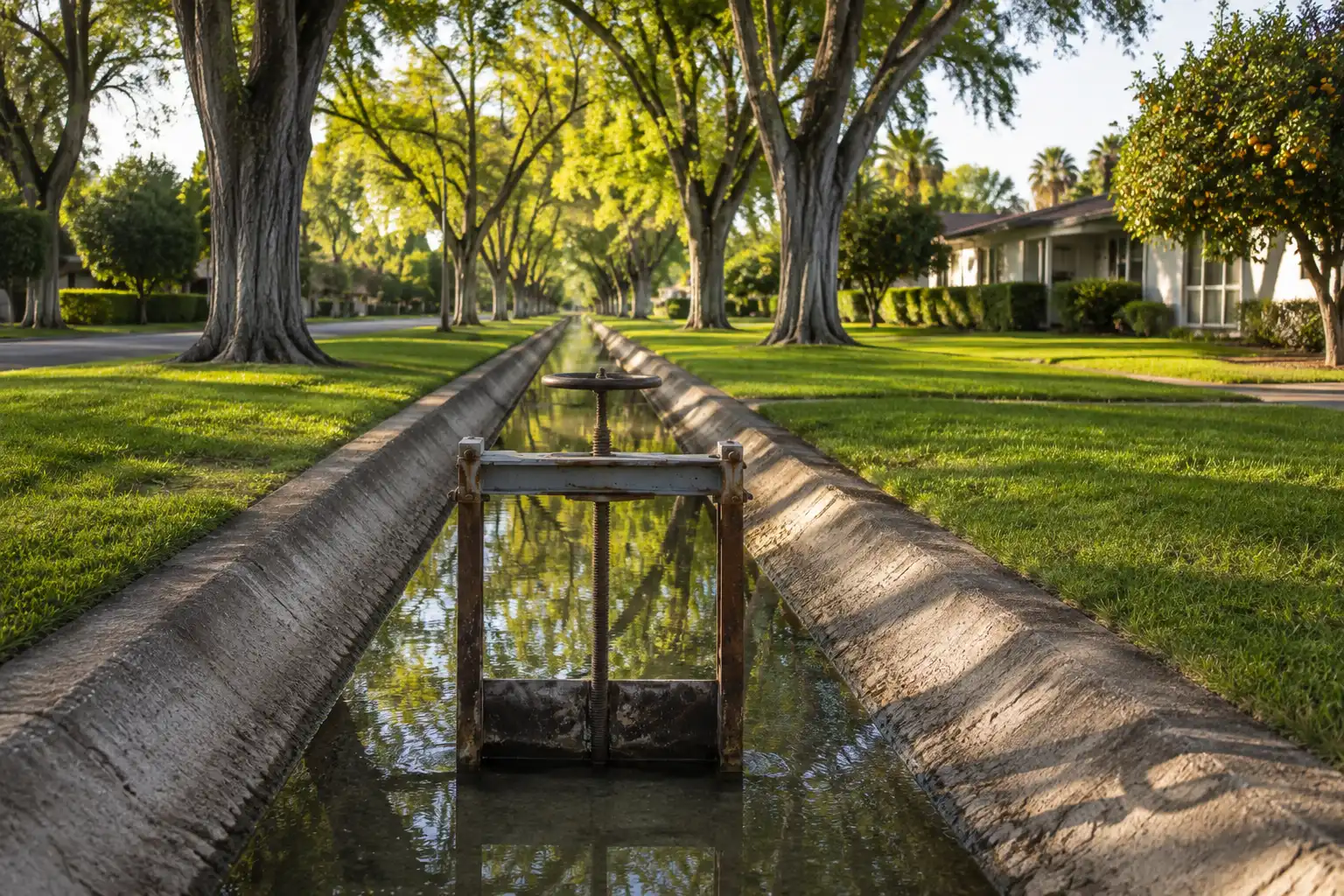
On irrigation day, an SRP employee known as a zanjero—Spanish for ditch rider—releases water into the neighborhood delivery system.
From there, things become much more property-specific.
Water may travel through an open ditch, underground pipe or shared private line before reaching an individual home. When your scheduled time arrives, a gate or valve is opened and the water spreads across the lot, slowly soaking deeply into the soil.
And yes, sometimes that happens at 2:00 in the morning.
Longtime Arcadia owners barely blink at this. Some handle their irrigation themselves. Others hire someone to manage it. On some streets, neighbors have been sharing the same system—and coordinating with one another—for decades.
It is one of those slightly quirky pieces of old Arcadia that still exists beneath some of its most valuable real estate.
And Then There Is Arcadia Water Company
This is another distinction I want buyers to understand because domestic water and flood irrigation are not the same thing.
Depending on where a home is located, its household water may be supplied by the City of Phoenix or by Arcadia Water Company, a private water utility with deep roots in the development of the neighborhood.
Arcadia Water Company dates back to Arcadia’s earlier development, when this part of the Valley was still largely agricultural and well outside the urban Phoenix we know today. As homes were built among the citrus groves, a local water system was needed to serve them.
That system remains today.
There are properties within the older Arcadia area that receive their everyday household water—the water coming from the kitchen faucet, shower and hose—from Arcadia Water Company rather than the City of Phoenix.
This is separate from SRP flood irrigation.
A property can have Arcadia Water Company domestic water and SRP flood irrigation. Another nearby property may have city water and no active flood irrigation. That is why I never make assumptions based simply on an Arcadia address.
The older streets around the heart of Arcadia—Lafayette, Exeter, the Calle streets and the lanes tucked closer to Camelback Mountain—are exactly where understanding the history of an individual parcel becomes important.
Why Flood Irrigation Matters So Much Here
Because you cannot recreate seventy or eighty years of growth.
Some of Arcadia’s greatest assets aren’t inside the houses at all. They are the enormous trees, established hedges, citrus, lawns and gardens surrounding them.
Flood irrigation deeply saturates the soil rather than delivering water to one small area around a plant. Over decades, that has helped support the root systems of the mature trees that form Arcadia’s canopy.
It also helps flush accumulated salts deeper into our desert soil and away from the active root zone.
When I walk an Arcadia property with a buyer, I am looking at the trees almost as carefully as I am looking at the house.
A beautiful old ash, eucalyptus or citrus tree isn’t something you replace with a trip to the nursery. On the right property, those trees are part of its history—and absolutely part of its value.
Buying an Arcadia Home? Here’s What I Want to Know About the Water
First, who supplies the domestic water?
Is it Arcadia Water Company or the City of Phoenix?
Then, does the property have active SRP flood irrigation?
If it does, I want to know how the water reaches the property. Where is the valve or standpipe? Is the line shared? Who maintains it? Who handles the irrigation now? Are there shared expenses with neighboring properties?
I also look at the physical lot.
Is it properly graded? Are the berms intact? Where does the water collect? Does it stay safely away from the house? How are the mature trees being watered?
These may sound like small details compared with square footage, finishes or the kitchen.
In Arcadia, they aren’t.
The Streets Tell Some of the Story
One of the reasons I love selling Arcadia is that it isn’t one homogeneous neighborhood.
Lafayette has its own feel. Exeter has another. The Calle streets have another. Move north toward Camelback Mountain or south toward the older ranch properties and the lots, architecture, landscaping and even pieces of the original infrastructure begin to change.
That is why “Does this house have irrigation?” isn’t quite enough.
The better questions are: Where does its water come from? Does it still have irrigation rights? How does the private system work? And what has been preserved from the original property?
Those answers can tell you quite a bit about an Arcadia home.
Part of What Makes Arcadia, Arcadia
Arcadia’s canopy exists because generations of owners kept watering it.
The infrastructure that once supported citrus groves and farmsteads still influences properties along Lafayette, Exeter and some of the neighborhood’s oldest streets today. Arcadia Water Company is another surviving piece of that history.
To me, that isn’t outdated infrastructure to be dismissed. It is part of understanding why this neighborhood developed the way it did—and why it still doesn’t look or feel like anywhere else in Phoenix.
After nearly 30 years of walking these properties, I’ve learned that some of the most important things about an Arcadia home aren’t necessarily the things you’ll see in the listing photos.
Sometimes they’re running underneath the yard.
And those are exactly the things I want to understand before my buyer writes an offer.
Sources for current service, delivery schedules and property-specific information should be confirmed directly with Salt River Project and Arcadia Water Company.
Social Cookies
Social Cookies are used to enable you to share pages and content you find interesting throughout the website through third-party social networking or other websites (including, potentially for advertising purposes related to social networking).